Cthulhu and the Unconscious
Blog post description.
10/9/20252 min read
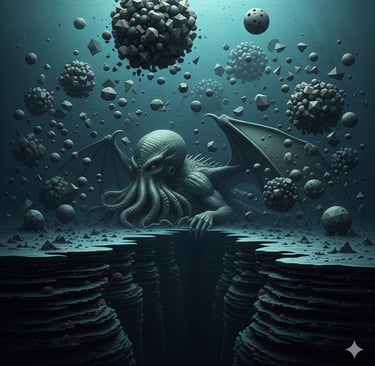
Those who have experienced the disturbing power of nightmares will understand why some people just love Lovecraft. He shares with us the solitude of one's own mind—the fear of falling locked inside your own jail. In some way, everyone is cautious about opening that Pandora's box, in which there is no exit; but it is the direct way to face yourself.
Here is a selection from Llopis's prologue, written for the anthology he compiled in his book: Los mitos de Cthulhu: Narraciones de horror cósmico: The Cthulhu Mythos: Tales of Cosmic Horror. The stories featured in this edition are among my favorites, as they were a introduction to the Lovecraftian universe. It reads as follows:
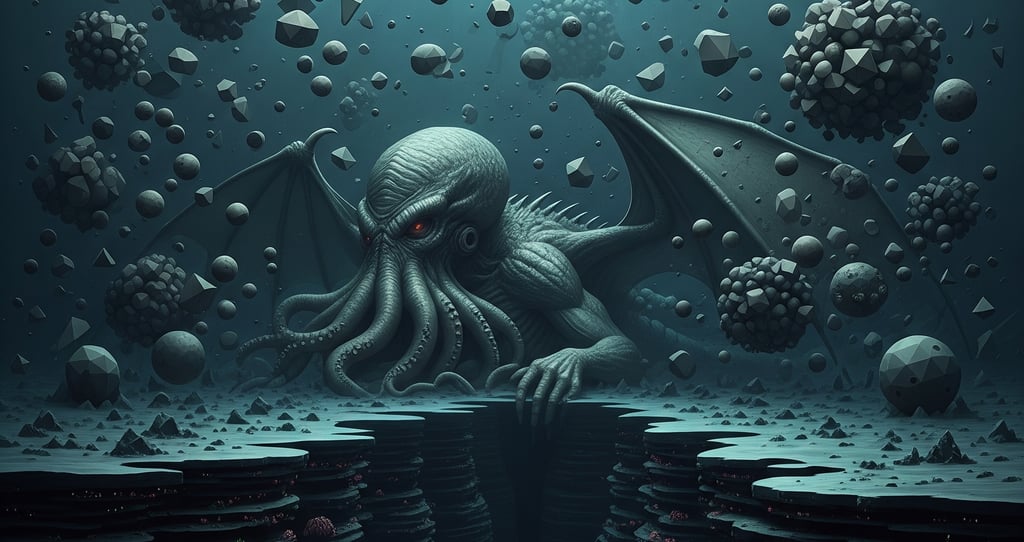
"Before the human species and lethargic by the hegemony of man, the primitives - huge amorphous masses - hope and dream of once again dominating the earth. The great god Cthulhu, the most evil and important of them, lies at the bottom of the sea. From a symbolic point of view, all this is rigorously true. At the bottom of the sea - which is the cradle of life and a symbol of our own prehuman unconscious - or in the bowels of the earth, in archaic geological strata that symbolize archaic levels. of the mind, are our most ancestral terrors and desires, those we inherited from our non-human ancestors, together with our brain structure and as a memory of a world then perceived through its irrational mind ^ 68." Llopis, R. (1970) Los mitos de Cthulhu: Narraciones de horror cósmico. Madrid: (?). Ver menos"
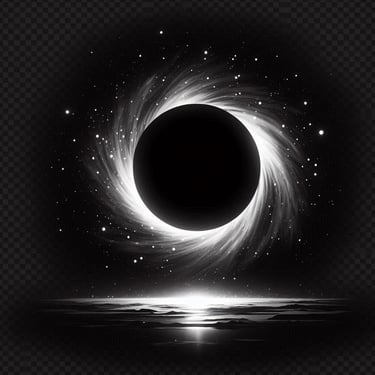
This passage also evokes what time travel has truly been. Not the time machine we usually think of, but perhaps the only one that has always existed: our mind. Without delving into how consciousness developed to the point we humans know it, let us look into the Great Old Ones: those amorphous masses of unknown nature that somehow established contact with humans. They show us the abysses of nothingness, the infinity of creation, and the meaninglessness of existence. Could this be similar to going through a black hole, in which your consciousness could probably last 'forever' while every particle of your body is taken apart? And being honest, no one wants to fall into a black hole—better dead than being spaghettified for the duration of the universe in there.
"But, in some way, we have to deal with those creations' singularities, and basically, there is no way to avoid these monsters visiting us in our dreams. There, our psyche—with just a glimpse of these astronomical objects—is irremediably drawn into the black hole and, according to this theory, converges in nightmares: the deepest fears, fantasies, and joys of the human soul; and visions that shouldn't be seen, which will haunt us as long as our memory lasts. And in the nakedness of reality and the cruelty of its touch—cold and sharp, as so many times in human history, yet sometimes warm and overflowing with passion, hope, and love— we hope for a sweet peace that could be reborn, but there is always an incertity of what it will come.
All that remains is to entrust ourselves to the protection of the designs conceived since the origins, or the eternities; to something that protects us from falling into the evil of the void.