The Unconscious
The Cthulhu Mythos: Tales of Cosmic Horror. Rafael Llopis (1970)
3/31/20255 min read
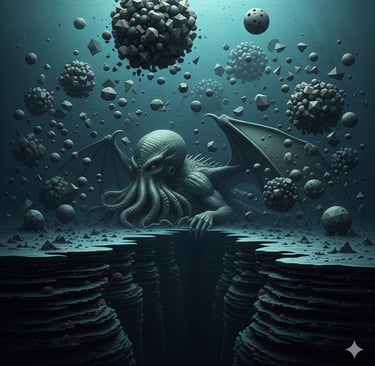
Those who have experienced the disturbing power of nightmares will understand why some people deeply love Lovecraft. And one of those possible reasons is that he reveals to us the profound solitude of the mind — the fear of being locked forever inside the prison of our own consciousness. In a way, we are all cautious about opening that Pandora’s box, knowing there may be no escape; yet it is also the most direct path to facing ourselves. And Rafael LLopis in this passage give us an interesting description of the unconscious.
This is a selection from Llopis's prologue, written for the anthology he compiled in his book: Los mitos de Cthulhu: Narraciones de horror cósmico: The Cthulhu Mythos: Tales of Cosmic Horror. The stories featured in this edition are among my favorites, as they were a introduction to the Lovecraftian universe.
It reads as follows:
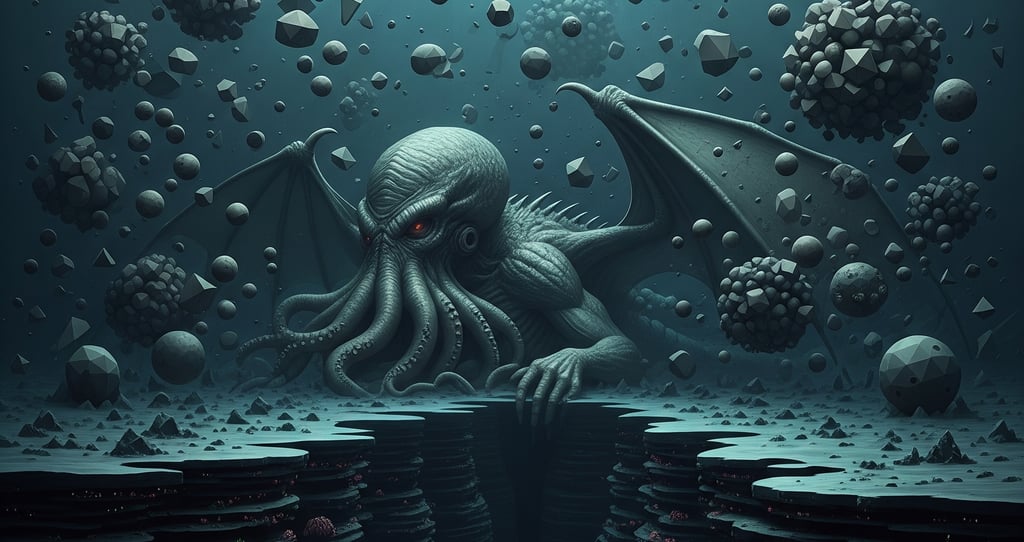
"Before the human species and lethargic by the hegemony of man, the primitives - huge amorphous masses - hope and dream of once again dominating the earth. The great god Cthulhu, the most evil and important of them, lies at the
bottom of the sea. From a symbolic point of view, all this is rigorously true. At the bottom of the sea - which is the cradle of life and a symbol of our own prehuman unconscious - or in the bowels of the earth, in archaic geological strata that symbolize archaic levels of the mind, are our most ancestral terrors and desires, those we inherited from our non-human ancestors, together with our brain structure and as a memory of a world then perceived through its irrational mind [68]." -- Llopis, R. Los mitos de Cthulhu: Narraciones de horror cósmico. Madrid, 1970.
As so many feelings and thoughts arose during this reading, I wanted to write about this: Time and Mind.
It is known that we, the entire universe and its creation, are traveling through and existing in space-time. In a figurative way, we can say the same about dreams. For example, have you ever had a dream in which you found yourself in a moment in the future or in the past — a moment we wish would happen or one we long for — while still having the possibility to intervene in it? We have this experience in our minds, and sometimes we wake up with a sensation that lasts forever, one that feels fresh every time we think about it.
But the truth is, we can only truly understand the concept of 'real' because we have experienced it. We have definitions for 'experience,' 'reality,' and 'time.' For the latter, physics needs it to describe nature, and we are deeply attached to it. Strictly speaking, time is not a thing; it is not a noun that exists independently. A dream and the ability of our mind and body to create those worlds can be explained by neuroscience and biochemistry, yet they remain just another set of definitions. Nevertheless, these definitions are widely accepted, and we are settled in this reality — living it, experiencing it, and dreaming it. We don’t even know if it belongs to us or if we belong to it. Are we its creators, or merely observers and spectators?
These are 'definitions' of something as immense as TO EXIST. Yet we also possess the power of 'words,' and as if that weren’t enough, this further reinforces the idea of the intangible within this very tangible universe.
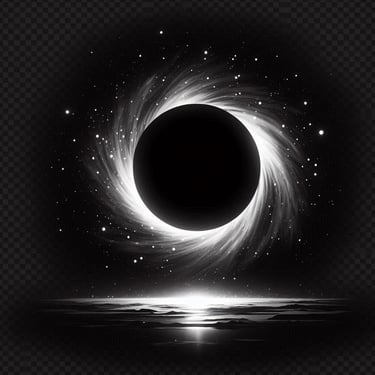
Now, coming back to Llopis and the Great Old Ones: those amorphous masses of unknown nature that somehow established contact with humans. They show us the abysses of nothingness, the infinity of creation, and the meaninglessness of existence. Could this be similar to falling into a black hole, where your consciousness could last 'forever' while every particle of your body is torn apart?
Think now about what the concept of experience means in this case — being dragged by a black hole. The only way to know that it is real is to live it. But honestly, no one really wants to experience it. Better dead than being spaghettified in there for who knows how long...
But anyway, we have to deal with those singularities of life. Probably similar to our physical world: if an object gets close enough to a black hole, it will be dragged into its heart. In the same way, our psyche behaves — with just a glimpse of those monsters, we will irremediably be drawn into Them. And this will converge into heaven or hell: the deepest fears, fantasies, and joys of the human soul, along with visions that should never be seen, will haunt us as long as our memory lasts. And again, who knows what it really means.
Why could this be possible? Maybe because they are made of the same material? Let’s suppose that if there were an algorithm or equation for the mind, it would be exactly the space-time equation. Therefore, we could say that mind := space-time. We could also consider the equation of light, but perhaps the space-time one would be more accurate.
The fact that an observer saw those monsters, felt them, or became aware of them — being there, at their Event Horizon — means that when they look back at him, this observer who was sniffing around the edge of nothingness will be dragged into their reign forever. This entire argument is based on a relationship of mathematical logic (based on the supposition we made earlier): the mind is equivalent to space-time. Therefore, they share the same properties. It was the mind that created those definitions of its environment and its interaction with it. In this case, we have reached a meta-definition: defining the words 'reality' and 'experience' using the mind — the only 'instrument' that can actually determine what they are — while also assuming that the observer is included in this definition.
Thus, things exist in this space-time as long as we observe them or name them, just as the observer modifies their/its “reality” by seeking to describe, define, experience, and do all those things. However, to avoid ending on too dramatic a note, let us consider three possibilities: either the entire universe came into existence at the very moment the first human opened their eyes to creation, or the universe has been observed almost since its beginning, ever since the appearance of the first thinking being, or is the universe its own observer? Or at the end, everything is like it is.
Perhaps the only time machine that has always existed is our mind. This is why it is so important to stay far away from the forbidden knowledge of The Great Old Ones — knowledge that can lead us to the loss of our souls and set us on a trip into the jaws of an eternal nightmare.
In the nakedness of reality and its touch — cold, as so many times in human history, yet sometimes warm and overflowing with love — we hope for a sweet peace that could fill our hearts. We entrust ourselves to the protection of those designs conceived since the origins or for all eternities, or to something, whatever it may be, that can protect us from falling into the evil of the void.